Why Nonprofits Are Moving Away from Spreadsheet Budgeting — And What AI-Powered FP&A Is Doing Instead
You didn't get into the nonprofit world to spend your weekends untangling spreadsheets.
But here you are — reconciling grant restrictions across 12 tabs, manually updating the board report for the third time this month, and praying nobody touches the master budget file before the audit.
This is the reality for a lot of nonprofit finance teams. And it doesn't have to be.
The organizations moving fastest right now aren't just switching tools. They're rethinking how financial planning works entirely — and AI is a big part of why the timing finally makes sense.
Why Spreadsheets Fail Nonprofits Specifically
Spreadsheets are flexible. That's exactly the problem.
In a nonprofit, flexibility without structure creates risk. Grant funds need to stay in their lane. Program budgets need to roll up into an org-wide view without losing their detail. Board reports need to reflect reality — not a version of reality that someone assembled manually at 11pm.
Here's where spreadsheets consistently break down for nonprofit finance teams:
Fund accounting is a nightmare to maintain manually. Every restricted grant has its own rules. Tracking spend against those restrictions across multiple programs, in a spreadsheet, with multiple people touching the file — that's a compliance risk waiting to happen.
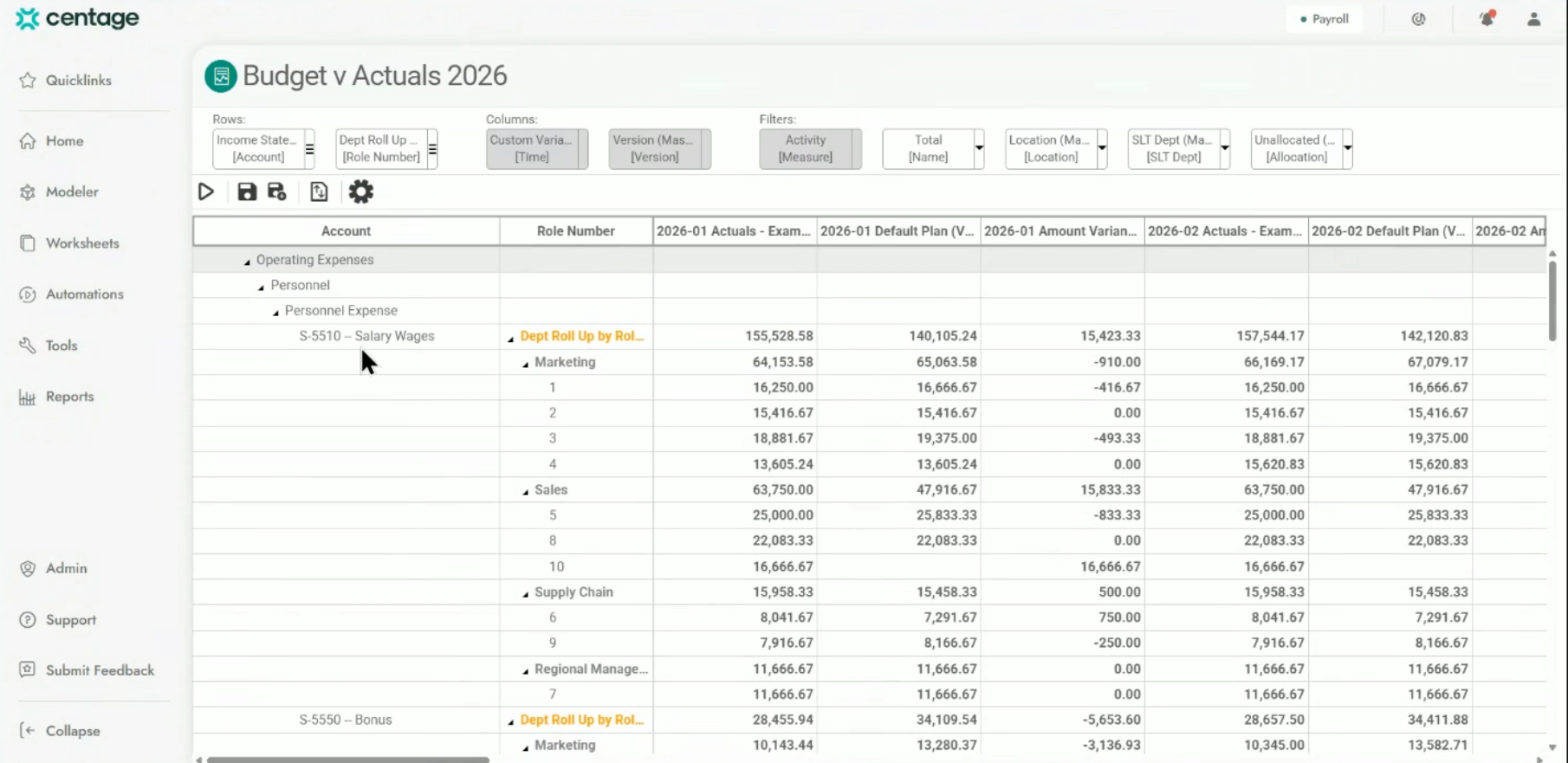
Budget vs. actuals reporting takes forever. Pulling together a clean report for the board or an executive director shouldn't require half a week of manual work. But when your budget lives in one place and your actuals live in another, that's exactly what happens.
Scenario planning is nearly impossible. What if that federal grant doesn't renew? What if a major donor reduces their pledge? In a spreadsheet, answering those questions means rebuilding your model. Most teams just don't do it — and that's a problem.
Version control is a constant threat. One wrong save, one formula overwrite, one person working in an outdated copy — and your numbers are wrong in ways you might not catch until it matters.
What Nonprofit Finance Teams Actually Need
The requirements for a nonprofit finance function aren't just "budgeting." They're a specific set of capabilities that general-purpose tools were never designed to handle.
Fund and Program-Level Budgeting
You need to budget at the program or fund level — tracking revenue and expenses for each grant, each initiative, each department — while also maintaining a consolidated organizational view. Most commercial FP&A tools make you choose one or the other. Purpose-built nonprofit tools handle both.
Grant and Restriction Tracking
Restricted funds need to be tracked separately, with clear visibility into what's been spent, what's remaining, and when the grant period closes. This isn't just a reporting nicety — it's a compliance requirement, and it needs to be built into the planning process, not bolted on after the fact.
Board-Ready Reporting Without Manual Assembly
Your board needs financial context, not raw data. The right FP&A software generates clean, professional reports directly from your live data — so the numbers in the board packet match the numbers in your system, every time, without a manual export-and-format process.
Multi-Scenario Planning for Funding Uncertainty
Nonprofits operate with inherent revenue uncertainty. Grants get cut. Fundraising falls short. A major contract doesn't renew. You need to be able to model those scenarios quickly — not as a once-a-year exercise, but on an ongoing basis as your funding landscape shifts.
Where AI Is Changing the Equation for Nonprofits
For a long time, AI in financial planning felt like something built for large enterprises with dedicated data teams. That's changed. And for nonprofits operating lean finance functions, the impact is especially meaningful.
AI-Assisted Forecasting for Unpredictable Revenue
Nonprofit revenue is notoriously hard to forecast — grant timing is lumpy, donation patterns are seasonal, and program revenue can be tied to factors outside your control. AI-powered forecasting analyzes your historical patterns and adjusts projections automatically as actuals come in, giving you a more accurate view of the year ahead without requiring your team to manually recalibrate every month.
Anomaly Detection Before It Becomes a Problem
AI can flag when spending in a specific program or fund is trending out of alignment with its budget — before you're over budget, and before you're in a compliance conversation you don't want to have. For teams managing multiple restricted grants simultaneously, this kind of early warning is genuinely valuable.
Faster Variance Analysis
When the board asks why program expenses came in 15% over budget last quarter, your finance team shouldn't spend three days figuring out the answer. AI-powered FP&A platforms surface the most likely drivers automatically, so you can walk into that conversation prepared — not piecing together an explanation on the fly.
Natural Language Reporting
Some platforms now let you ask financial questions in plain English and get a clear answer — no pivot tables, no manual cross-referencing. For nonprofit leaders who aren't finance specialists but need to understand the numbers, this changes how accessible financial data actually is across the organization.
What the Switch Actually Looks Like
Moving off spreadsheets feels bigger than it is. Most nonprofit finance teams that make the transition describe the same experience: the first month is an adjustment, and by month three, they can't imagine going back.
A few things that make the transition smoother:
Start with your chart of accounts. Before you move any data, make sure your fund and program structure is clearly defined. The software will follow your structure — not the other way around.
Bring your program leads in early. If department heads are used to submitting budget requests via email or shared spreadsheets, the shift to a collaborative planning platform requires some change management. The more they understand the why, the faster they adopt it.
Don't try to replicate your spreadsheets exactly. The temptation is to rebuild your existing process in a new tool. The better move is to let the tool show you a more efficient process.
Prioritize reporting first. Getting your board reports automated is usually the fastest win — and the one that builds the most internal momentum for the broader transition.
Centage's nonprofit FP&A solution is built specifically for the fund accounting, grant tracking, and multi-program reporting complexity that mission-driven organizations navigate every day.
The Real Cost of Staying in Spreadsheets
It's easy to frame spreadsheet budgeting as "free." But the actual cost is your team's time, your organization's accuracy, and your leadership's confidence in the numbers.
When your finance function is consuming 20+ hours a month on manual processes that software could automate, those are hours not spent on financial strategy, grant analysis, or the work that actually moves your mission forward.
The organizations getting the most out of their finance function right now aren't the ones with the biggest teams. They're the ones with the right tools — tools that handle the complexity of nonprofit finance so the people can focus on the decisions that matter.
The Mission Is Too Important for the Wrong Tools
Spreadsheets got nonprofits through a period when better options didn't exist. That period is over.
Purpose-built FP&A software — especially platforms with AI-powered forecasting, automated reporting, and fund-level planning — gives nonprofit finance teams the infrastructure to do their jobs without the manual overhead that's been quietly slowing them down.
Your board deserves accurate numbers. Your grantors deserve clean reporting. Your team deserves to stop rebuilding the same spreadsheet every month. The mission is too important to let the tools get in the way.
👉 See how Centage helps nonprofits budget by fund, track grant restrictions, and generate board-ready reports — without the spreadsheet chaos.
Frequently Asked Questions
Why can't nonprofits just use standard budgeting software?
Most standard budgeting tools are built around a simple revenue-minus-cost model. Nonprofits operate differently — with restricted funds, multiple programs, grant compliance requirements, and board reporting needs that general-purpose tools weren't designed to handle. Purpose-built nonprofit FP&A software maps to the way your organization actually works, rather than forcing you to work around the tool's limitations.
What is fund accounting and why does it matter for financial planning?
Fund accounting is the practice of tracking financial activity separately for each funding source — grants, donations, program revenue — to ensure restricted funds are spent according to donor or grantor intent. It's a compliance requirement for most nonprofits, not just a reporting preference. When your FP&A software supports fund accounting natively, budget tracking and grant reporting happen in the same system instead of across disconnected spreadsheets.
How does AI actually help nonprofit finance teams?
For lean nonprofit finance teams, AI helps most in three areas: forecasting unpredictable revenue streams like grants and donations, detecting budget variances in restricted funds before they become compliance issues, and automating the variance analysis that usually takes days to pull together manually. The net result is less time on manual work and more time on the financial decisions that actually move the mission forward.
How hard is it to switch from spreadsheets to FP&A software?
Less disruptive than most teams expect. The biggest upfront investment is defining your fund and program structure clearly before migrating — the software will follow your chart of accounts. Most nonprofit finance teams are fully operational within a few months, and the most common feedback is that board reporting and grant tracking get dramatically easier within the first quarter.
What should nonprofits look for when evaluating FP&A software?
Five things worth prioritizing: native fund and program-level budgeting, grant restriction tracking built into the planning process, board-ready reporting that generates directly from live data, multi-scenario planning for funding uncertainty, and AI-powered forecasting that adjusts as actuals come in. If a platform can't demonstrate all five with your real use cases during a demo, keep looking.
Keep reading...
Interviews, tips, guides, industry best practices, and news.

Cash flow forecasting for mid-market CFOs: the driver architecture that holds up across healthcare, nonprofit, manufacturing, distribution, and professional services