The Best FP&A Software in 2026: A Buyer's Checklist
The best FP&A software in 2026 is the one that removes spreadsheet risk without adding enterprise complexity — a middle ground of automation, workforce planning, and multi-entity consolidation at a price a mid-market finance team can actually clear.
You didn't fail. Your company outgrew Excel. If the finance team is spending six weeks a cycle on linked workbooks, hunting broken formulas, and rebuilding a personnel model by hand, the tool broke — not the people running it.
This page evaluates thirteen credible FP&A software platforms for finance teams at growing mid-market companies. The target buyer: $25M-$500M in revenue (or $5M-$100M in operating budget for nonprofits), 2 to 10-person finance team, managing multiple departments, locations, or entities, budget cycles taking 3 to 6 weeks, considering enterprise FP&A but seems like overkill. The eight criteria below decide most buying decisions in that segment. The vendor block that follows tests each platform against them.
What to look for in FP&A software
Time-to-first-forecast
Measure how many weeks pass between contract signature and the first CFO-usable forecast. Enterprise platforms with dedicated systems-integrator engagements measure this in quarters — 6 to 12 months typical. Mid-market platforms with bundled implementation measure it in weeks. Centage runs 4 to 6 weeks, finance-owned, no IT team required. Ask any vendor for two named references at your size that went live in the past twelve months.
Native integration surface
Count the shipped, supported integrations — not the "we can connect via API" claim. Three integrations decide most deals: the general ledger, the HRIS or payroll system, and the source of truth for actuals in the business. If any of the three is a custom build, add three months and $30K to the implementation timeline. AI-mapped connectors that read ERP structure automatically shorten the setup further.
Workforce planning depth
Personnel is the largest line item for most service organizations. Test the platform against the pay structures the business actually operates: hourly plus overtime, tipped, variable commissions, grant-funded compensation, benefits and taxes rolling up to fully-loaded cost. Merit increases, new hires, and headcount cuts should be modelable in minutes. Native ADP, UKG, and Paylocity connections are the market standard. Bolt-on modules quoted separately are a signal to keep looking.
True multi-entity and multi-location consolidation
For finance teams managing multiple departments, locations, or entities, the platform needs to consolidate them automatically — not through a manual spreadsheet export. Test it against unlimited entities, automated intercompany eliminations and reconciliations, and multi-currency support with real-time conversion. This is the class of computation that breaks Excel workbook chains and forces the switch in the first place.
Governance and audit trail
Every changed number should carry a who-changed-what-when trail. For nonprofits with grant compliance, healthcare systems with regulatory reporting, and any organization presenting numbers to a board, this is table stakes — not a premium feature. Ask to see the actual audit log during the demo. If it comes back as a roadmap item, discount the platform accordingly.
Practical AI, not AI for its own sake
Every vendor now ships an AI assistant. The one worth trusting shows its work — a traceability layer that lets a controller verify a variance narrative back to the underlying journal entry. Centage uses AI specifically to eliminate manual setup: reading ERP structure to map integrations, and grouping the chart of accounts into meaningful financial categories.
Onshore, finance-literate support
Bundled implementation, a named Customer Success Manager, and a response-time SLA in the contract. Offshore ticket queues and "community forums plus tickets" are red flags for a mid-market finance team without a dedicated FP&A analyst. Centage staffs its Customer Success organization with FP&A practitioners. One Centage customer described their CSM this way: "She doesn't just know the software — she knows the finance."
Total cost of ownership over three years
Add license, implementation, annual escalation (5 to 10% is typical), incremental user seats, and premium support. Anaplan customers routinely spend 1.5 to 3x license fees on systems integrators. Only two of the thirteen vendors compared below bundle implementation into the subscription: Centage and Abacum. Everyone else quotes implementation separately, and only a small minority publish tier pricing at all.
The top FP&A software vendors, honestly compared
Thirteen credible vendors in the 2026 shortlist. Each entry names the best-fit buyer, the trade-off, and the honest limitation. No sponsored placements.
- Centage — Best for: mid-market finance teams ($25M-$500M revenue; $5M-$100M nonprofit operating budget) that outgrew Excel and don't need enterprise complexity. Centage automates budgeting, forecasting, and workforce planning across multiple departments, locations, and entities. The Personnel Module handles hourly, variable, tipped, and grant-funded compensation with native ADP, UKG, and Paylocity connections. Multi-entity consolidation and intercompany eliminations run automatically. Year-1 investment is $18K-$40K, implementation bundled, live in 4 to 6 weeks, finance-owned, no IT team required. Kyle Raeder, Director of Reimbursement & Financial Planning at Community Care, Inc.
"Centage gave us the flexibility we knew we needed, but thought we couldn't achieve. It allowed us to totally change our approach to the budgeting process."
- Workday Adaptive Planning — Best for: large enterprise with a dedicated FP&A team of 10 or more and an existing Workday HCM or Financials footprint. Mature modeling, ML forecasting, deep governance, and OfficeConnect. Year-1 TCO clears mid-six figures on typical mid-range enterprise deployments; expect a 6 to 9-month implementation. Best fit when Workday is already the system of record; not a fit for a five-person finance team that needs a working forecast next month.
- Cube — Best for: spreadsheet-first mid-market teams that want a light governance layer without leaving Excel or Google Sheets. Cube treats spreadsheets as first-class UI and adds a governance layer around them. In Jun 2026, Cube shipped unlimited users and dimensions across all tiers plus the Cube MCP Server for AI-assistant access. Entry pricing runs $20K-$40K/year; mid-market $50K-$120K. Modeling engine stays in the spreadsheet, which is the design — governance without displacement.
- Vena Solutions — Best for: Excel-native finance teams that need governance, workflow controls, and audit trail on top of workbook modeling. Vena is the Excel-plus-governance benchmark. Named-user pricing scales fast with team size; Year-1 TCO typically runs $75K-$225K, with systems-integration fees of $20K-$60K quoted separately. Excel modeling depth is real. So is the learning curve. Best when the finance team has existing spreadsheet discipline and needs the workflow layer without a rip-and-replace.
- Pigment — Best for: high-growth SaaS finance teams needing driver-based, cross-functional modeling with transparent assumptions across departments. Pigment ships one of the cleaner visual planning interfaces in the category and enables non-finance stakeholders (sales ops, RevOps, HR) to model in the same canvas. Quote-only pricing; mid-market deployments typically run $75K-$200K Year-1. Requires structured source data and typically a partner-assisted rollout. Enterprise consolidation and multi-entity features are still maturing relative to older incumbents.
- Vareto — Best for: Series B-D SaaS finance teams wanting a real-time GL layer and modern UX. Vareto is the newer SaaS-finance native. Live GL integrations mean actuals stay current without a monthly refresh, and the product is strong on SaaS-specific KPIs (ARR, net revenue retention, magic number). Quote-only pricing; mid-market deployments run $50K-$150K. Weaker on multi-entity consolidation, service-economy verticals, and the deep integration ecosystem the incumbents have accumulated.
- Anaplan — Best for: Fortune 500 connected planning across finance, supply chain, and sales at global scale. Anaplan is the enterprise reference platform. 48 percent of the Fortune 50 use it. Modeling depth is real; scale is real; the price is real. Year-1 TCO clears $500K and can pass $2.5M with systems-integrator fees at 1.5-3x license. Best fit for global enterprises with a dedicated planning team of twenty-plus. Not in the same buying decision as any mid-market platform.
- Prophix — Best for: mid-market finance teams wanting automated close and consolidation alongside FP&A from a single vendor. Prophix is a legacy mid-market platform with strong close-and-consolidation automation, predictive forecasting, and per-user role tiering. Quote-only pricing; typical mid-market spend is $65K per year, range $50K-$200K, with implementation quoted separately at $5K-$50K+. Steep initial setup learning curve. The Jun 2026 removal of localized pricing-page navigation suggests continued movement upmarket.
- Board — Best for: complex operators (manufacturing, retail networks) needing FP&A, business intelligence, and analytics in one platform. Board unifies planning, BI, and analytics — useful when the same operator needs planning plus operational reporting plus dashboards without three separate tools. Quote-only pricing; Year-1 deployments run $100K-$400K. Configuration is heavy; the flexibility that makes Board powerful also makes it slow to stand up. Usability lags cleaner-UX competitors like Pigment and Cube.
- Datarails — Best for: Excel-native small and mid-market finance teams, particularly in service-economy verticals (nonprofit, healthcare, hospitality, professional services). Datarails quietly built real vertical depth — dedicated landing pages with grant tracking, restricted-fund accounting, and industry-specific templates. Year-1 TCO $30K-$80K, with systems-integration fees $5K-$20K quoted separately. Genius AI assistant. Closest competitor to Centage on price and service-economy positioning; the workforce-planning depth is where Centage's Personnel Module still edges Datarails.
- Jirav — Best for: growth-stage small and lower-mid-market companies, plus accounting firms serving multiple clients. Prebuilt connectors for QuickBooks, Xero, NetSuite, Gusto, Rippling, HubSpot, and Salesforce mean setup is measured in days. Driver-based planning with ML forecasting. Typical spend is $20K-$50K/year. Best when speed to first working forecast matters more than modeling depth. Hits ceilings at true mid-market complexity — multi-entity consolidation and custom integrations require workarounds.
- Planful — Best for: horizontal mid-market and enterprise finance teams that value packaged AI features and integrated FP&A plus close. Planful is a G2 Leader in both mid-market and enterprise Budgeting and Forecasting grids. AI suite has real breadth (Analyst, Planner, Projections, Signals, Predict). Workforce Pro shipped Headcount Rollforward and Excel-integrated compensation modeling in Jun 2026. Priced at 6-25x Centage's mid-market range ($250K-$500K/year typical); no vertical landing pages for service-economy operators.
- Abacum — Best for: mid-market startups and scale-ups that need self-service, workflow automation, and no systems-integrator dependency. Abacum bundles implementation, runs 4 to 8-week sales cycles, and starts at $15K pilot pricing. Strong on workflow automation and scenario analysis. Best fit for high-growth companies with a small finance team that needs to move without SI dependency. Horizontal positioning; multi-entity consolidation and vertical depth trail incumbents like Datarails and Centage.
FP&A software FAQs
What is FP&A software?
FP&A software is the toolset finance teams use to build annual budgets, run rolling forecasts, model scenarios, close variance analyses against actuals, and report to executives and boards. Modern platforms handle multi-entity consolidation, workforce planning, driver-based revenue models, and native integration to the general ledger, HRIS, and CRM. FP&A software sits between the ERP, which records the past, and the boardroom, which decides the future.
How much does FP&A software cost in 2026?
Year-1 all-in cost for FP&A software in 2026 ranges from $18K at the mid-market entry point to $2.5M-plus at Fortune 500 scale. Three cohorts hold. Mid-market value tier: $18K-$80K per year — Centage, Datarails, Cube. Mid-market mainline: $40K-$200K — Prophix, Vena, Abacum. Enterprise: $250K-$2.5M-plus — Planful, Anaplan, Workday Adaptive Planning. Only Centage and Abacum bundle implementation into the subscription; the rest quote implementation separately.
How long does FP&A software take to implement?
Implementation timelines cluster by tier in the FP&A software market. Small and lower-mid-market platforms like Jirav, Cube, Datarails, and Abacum deploy in weeks, typically 30 to 60 days. Mid-market platforms with heavier modeling, including Centage, Vena, Prophix, and Pigment, run 4 to 16 weeks; Centage specifically runs 4 to 6 weeks with implementation bundled and no IT team required. Enterprise platforms like Anaplan, Workday Adaptive Planning, and Board run 6 to 9 months.
What integrations should FP&A software have?
Three shipped integrations decide most FP&A software deals. First, the general ledger — NetSuite, Sage Intacct, QuickBooks, Microsoft Dynamics, or Workday Financials. Second, the HRIS or payroll system — ADP, Paylocity, UKG, or Workday HCM. Third, the actuals source specific to the business: Salesforce for revenue teams, Snowflake or BigQuery for data teams, POS for hospitality. Available via API is not the same as shipped — verify each connector live in the demo.
Is AI in FP&A software ready to trust yet?
AI features are now standard across FP&A software — variance narratives, forecast suggestions, natural-language querying. What separates credible AI from a hallucination generator is traceability: can a controller click through an AI-generated narrative to the underlying journal entries and dimensions the number was built from. Centage keeps AI grounded in specific mechanical tasks like reading ERP structure to map integrations and grouping the chart of accounts — an implementation accelerator and hallucination free.
What is the best FP&A software for mid-market companies?
For a mid-market company with $25M to $500M in revenue and a 2 to 10-person finance team, the best FP&A software is one that fits between spreadsheets and enterprise platforms. Centage occupies that middle ground with a 4 to 6-week implementation, a built-in Personnel Module for workforce planning, automated multi-entity consolidation, and $18K to $40K annual pricing. Datarails and Cube are the closest mid-market alternatives on price. Enterprise platforms like Anaplan or Workday Adaptive Planning are overbuilt for this segment.
The verdict
Thirteen credible vendors, three price cohorts, one buying decision per finance team. The pattern that decides most deals: the finance team narrows on cycle time, integration surface, and price-to-outcome before it narrows on AI feature checklists.
For finance teams at growing mid-market companies — $25M to $500M in revenue, 2 to 10 people, managing multiple departments, locations, or entities — Centage is the right-sized middle ground. Enterprise FP&A power. Mid-market timeline and price. Personnel is a first-class module, not a bolt-on. Multi-entity consolidation and intercompany eliminations run automatically. Onshore Customer Success Managers with FP&A backgrounds pick up the phone. Implementation runs 4 to 6 weeks, finance-owned, no IT team required. Year-1 investment is $18K to $40K — a fraction of the $100K-$200K+ that enterprise platforms charge for the same class of automation.
FP&A software that frees you from spreadsheet chaos.
Get a Demo → — book a working session with a Centage FP&A expert who has stood up the platform for the reference customer closest to your operating model. 4-6 week implementation. Onshore support.
Compare head-to-head: Centage vs Planful · Centage vs Datarails · Centage vs Vena · Centage vs Anaplan
Keep reading...
Interviews, tips, guides, industry best practices, and news.
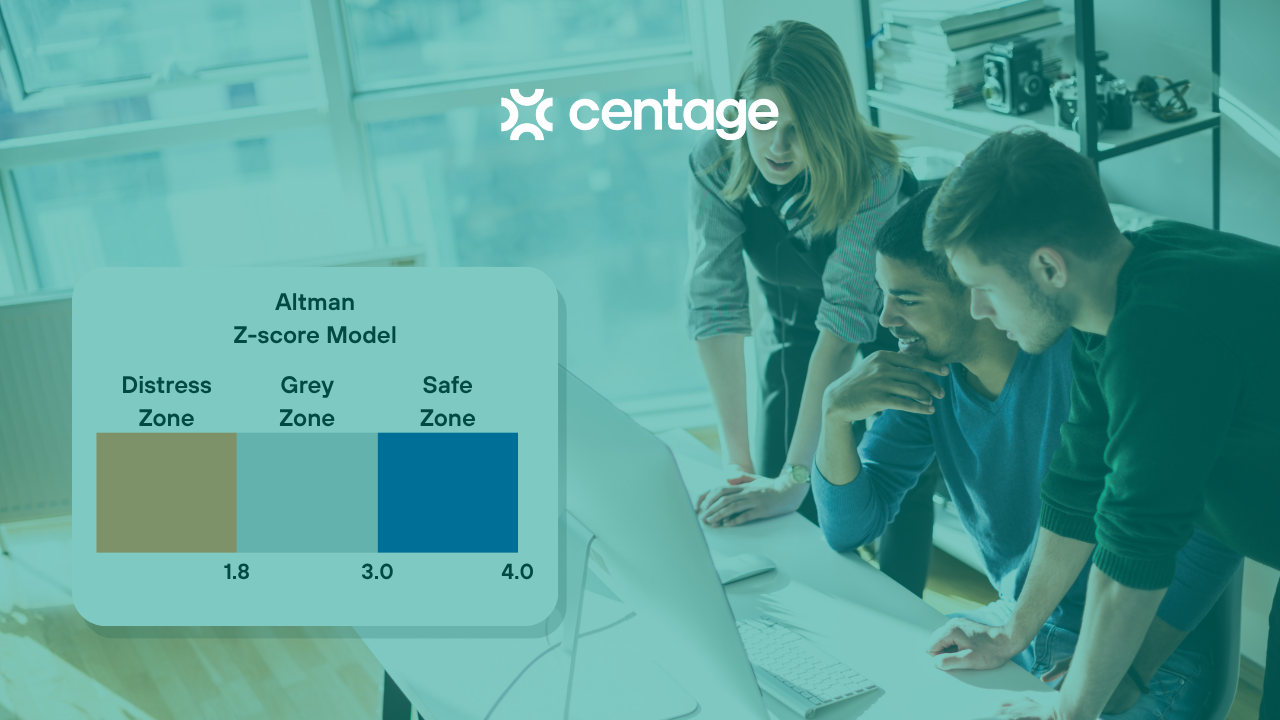
Running the Altman Z-score in every FP&A loop