We Just Launched Our Best Dashboards Ever. Here’s What’s Coming Next.
We Just Launched Our Best Dashboards Ever. Here’s What’s Coming Next.
Blog Post By Kate Drenckhahn, VP of Product at Centage
I’ve spent a lot of time talking to finance teams about what gets in their way. And the answer is almost always some version of the same thing: the tools they’re using were built to capture data, not to communicate it.
They can build the budget. They can run the forecast. But when the CFO walks into the board meeting and needs to show what’s happening in the business right now, at a glance, without a thirty-slide deck, the FP&A platform they use every day can’t help them. They’re back in Excel. They’re exporting CSVs. They’re rebuilding the same report they built last quarter.
The gap between the planning environment and the intelligence layer is exactly what we’ve been building toward. And today, with the launch of our most significant dashboard update in Centage’s 20-plus-year history, we’re taking the first real step toward closing it.
This isn’t just a dashboard refresh. It’s the foundation for something bigger: embedded Business Intelligence, built natively into the FP&A platform mid-market finance teams already use every day.
- Paul Lynch, CEO, Centage
What We Actually Shipped
Let me clarify what is currently in beta and will be available to all customers by the end of April.
The updated dashboard experience will include:
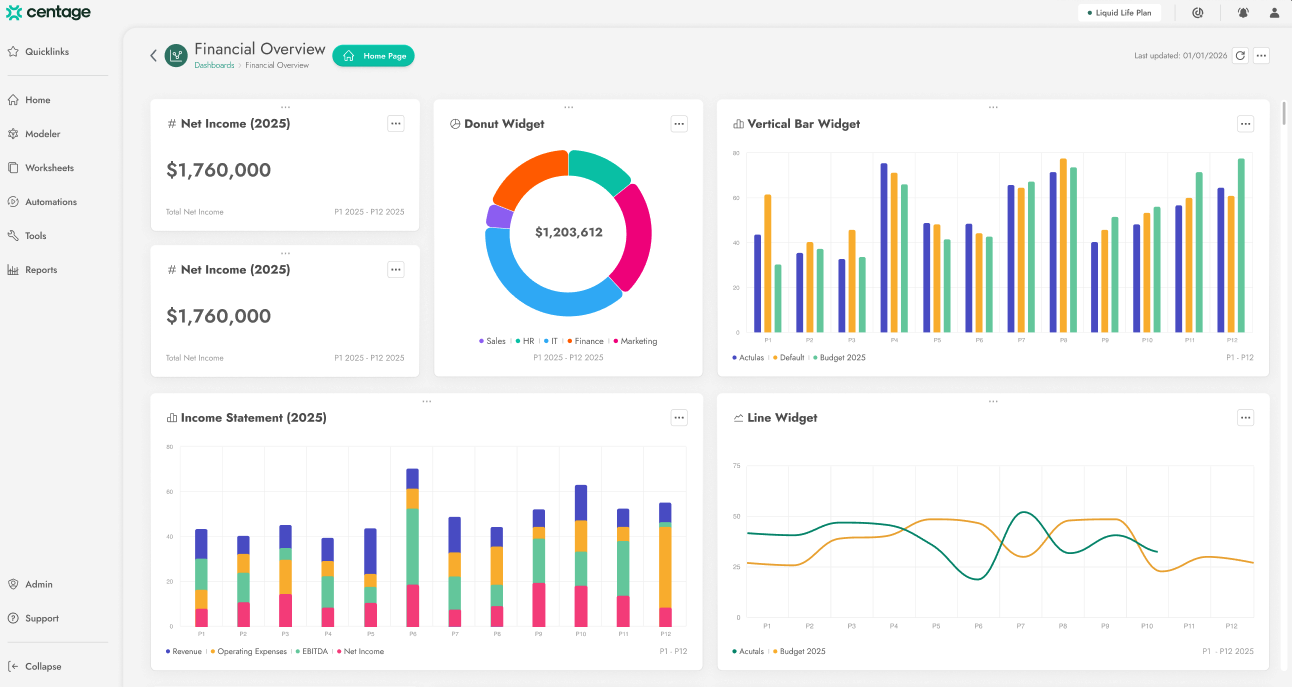
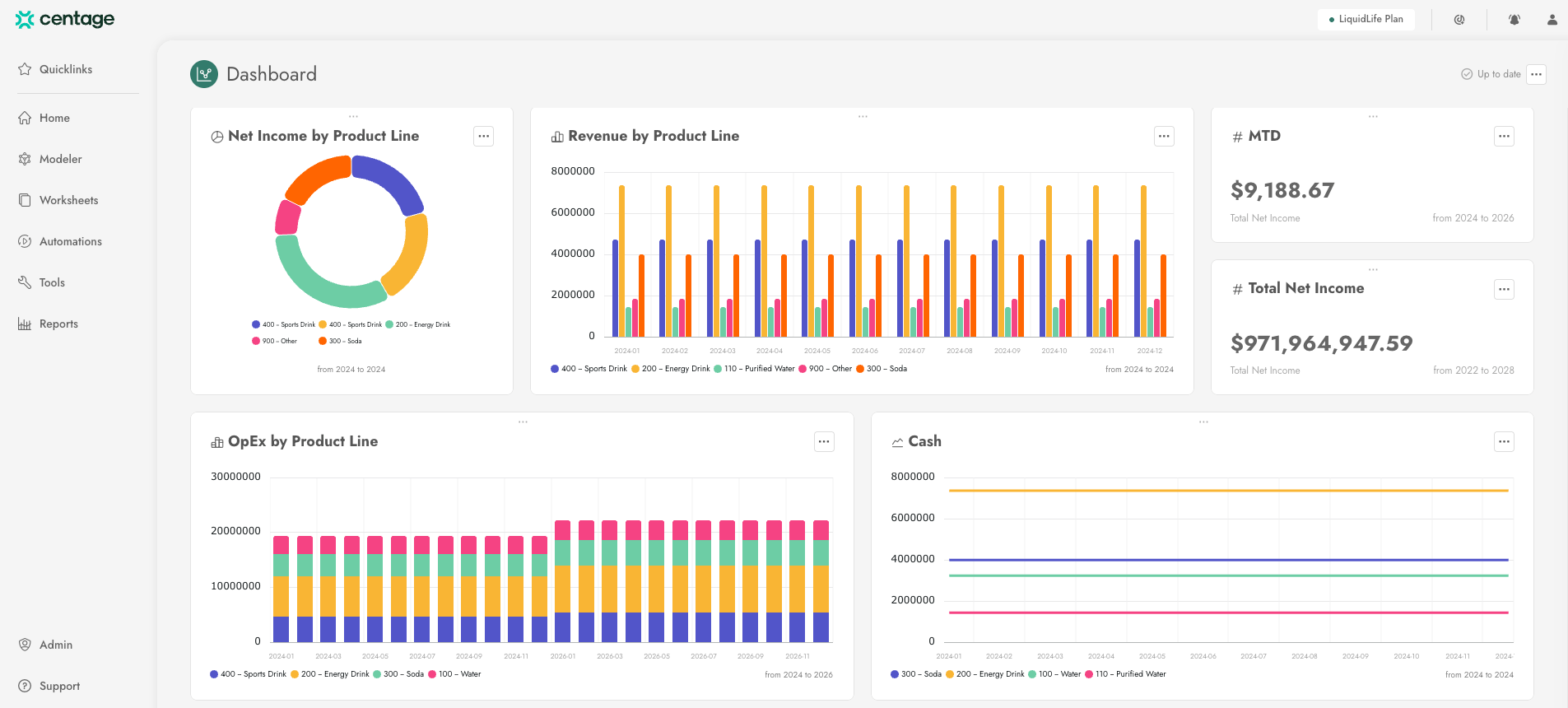
- Enhanced visualization capabilities: More chart types, better rendering, and layouts designed for how financial data actually needs to be read, not just displayed. We’re talking about visualizations that can handle the complexity of a multi-entity P&L or a rolling 12-month variance analysis without forcing you to simplify the underlying data.
- Dual-audience UX: One of the things we heard consistently in product research was that the person building the dashboard and the person consuming it have completely different needs. The analyst needs flexibility, drill-down, and control. The executive needs clarity, speed, and confidence. We’ve redesigned the experience with both in mind.
- Board-ready output natively in Centage: Finance teams can now export the entire dashboard to PDF or export individual widgets as .png to be used in presentation decks.
What we didn’t ship: a bolt-on. This wasn’t a third-party BI tool stitched onto the side of an FP&A platform. Every visualization pulls from the same data model, the same chart of accounts, the same version of truth that your budget and forecast are built on. That coherence is what makes it actually useful rather than just visually impressive.
Why the Sequencing Matters
I want to explain why we built dashboards before we built the broader BI feature set, because it’s not obvious, and the reasoning matters for understanding where we’re going.
You can’t build intelligent analytics on top of weak infrastructure. A lot of BI tools in the market look incredible in demos and then fall apart in production because the underlying data pipeline can’t support the complexity of real financial models. We’ve seen this with customers who came to us after trying to layer Tableau or Power BI onto their FP&A workflow. The visualization works. The integration doesn’t. Or the integration works, but the data model is too rigid to reflect the way the business actually runs.
So before we build AI-driven analytics, automated anomaly detection, or trend surfacing, all of which are coming, we needed three things to be rock solid:
- A real-time data layer with reliable ERP connectivity. ✔ (Solved with the AI Integration Framework in January.)
- A financial data model that’s flexible enough to reflect how mid-market businesses actually structure their GL. ✔ (Solved with AI Account Group Mapping in February, which eliminates rigid manual mapping.)
- A visualization layer that can render complex financial data cleanly for multiple audiences. ✔ (That’s what we shipped today.)
The AI-powered BI features we’re building next don’t work without all three of those layers underneath them. We’re not cutting corners on infrastructure to ship a flashy demo. We’re building this the right way. - Artur Kremens, VP of Engineering, Centage
The BI Roadmap: What’s Actually Coming
Here’s what the next phase looks like, and why I’m genuinely excited about it.
Mobile reporting and dashboard app. Finance teams make decisions in conference rooms, on flights, during board prep sessions that happen at inconvenient hours. The insight layer shouldn’t live only on a desktop. We’re building a mobile experience that puts live financial dashboards wherever the decision-maker is, not a read-only PDF, but a real-time, interactive view of the numbers that matter.
AI-powered BI features. This is the big one. We’re building analytics that don’t wait to be asked. Rather than a finance analyst spending three hours pulling data to answer “why is EBITDA down this month,” the system surfaces the answer automatically, from your data, with the context to understand what’s driving it. Trend identification, anomaly flagging, variance narratives, strategic recommendations. All of it grounded in the same financial model your budget is built on.
The key design principle we’re holding to: AI that amplifies finance analysts, not AI that tries to replace them. The finance professional should still be the one interpreting the insight and making the call. The AI handles the data sifting so they can spend their time on the part that actually requires human judgment.
I’ll be honest: this is the release I’m most excited about. But it only works because of the infrastructure we’ve been building all year. Which brings me to the broader context.
What a Year of Shipping Looks Like
This dashboard release is the seventh significant product update we’ve shipped in the last 13 months. I’m going to list them, not to brag, but because the pattern matters:
- Maestro (March 2025) — Our AI-powered FP&A co-pilot. The first signal that Centage was going to take AI seriously as a product capability, not just a marketing angle.
- Enhanced Worksheets (March 2025) — Excel-level flexibility inside a governed, collaborative planning environment. The feature we heard requested more than almost anything else. No plugins, no version hell, no broken formulas when someone renames a tab.
- Spread Method Wizard (March 2025) — A step-by-step, visual interface for one of the most tedious parts of budget building. If you’ve ever manually spread annual figures across months, you know exactly why this mattered.
- Real-time payroll integrations (2025) — On-demand connectivity to payroll systems so that headcount and compensation data flows directly into the planning model. For most mid-market companies, personnel costs are 60–70% of opex. Not having up-to-date data on your largest cost line is a problem we could fix, so we fixed it.
- AI Integration Framework (January 2026) — The industry’s first FP&A platform to use generative AI to automatically write custom ERP integration code. Cut onboarding from 8–12 weeks to 48–72 hours. Full ETL audit trail, and SOC 2 Type I compliant.
- AI Account Group Mapping (February 2026) — One click to map hundreds or thousands of GL accounts to Centage account groups. What used to take weeks of manual work now takes minutes. Customers review the outliers and get to planning immediately.
- Enhanced Dashboards (Today) — The visual intelligence layer. The opening move in our embedded BI journey.
Each of these addressed something that was a real pain point for real customers. None of them were demos. All of them are in production.
Why the FP&A + BI Gap Is a Mid-Market Problem Specifically
Enterprise companies have always had options. They buy Tableau or Power BI, hire a data engineering team to maintain the pipelines, and deal with the complexity because they have the resources to absorb it. The result is powerful but expensive, slow to implement, and disconnected from the FP&A workflow.
Mid-market finance teams don’t have that luxury. They’re three to eight people. They don’t have a data engineering team. They can’t absorb six-month BI implementations. But they still have to show up to board meetings, present to investors, and answer questions from a CEO who wants a live answer, not a report that’s three days old.
The tools that exist for them have forced a choice: use your FP&A platform for planning and figure out reporting yourself, or buy a standalone BI tool and deal with the integration nightmare. Neither option is good.
Centage is collapsing that distinction. Not by building a BI tool separately and bolting it on, but by extending the FP&A platform into the intelligence layer so finance teams work in one environment, with one data model, and get both planning and analytics from the same place.
That’s the bet we’re making. And based on the conversations I have with customers, it’s the right one.
What This Means for You Right Now
If you’re a current Centage customer, the updated dashboards will be coming at the end of April. If you want a walkthrough of the new capabilities or an early look at what’s coming on the BI roadmap, reach out to your account manager.
If you’re evaluating FP&A software and BI is on your requirements list, I’d encourage you to ask every vendor you’re talking to how their BI features are actually connected to their data model. Are they pulling from the same source of truth as the budget? Does the visualization layer update when actuals come in from the ERP? Can the same platform handle both the analyst building the model and the executive reading the dashboard? For most vendors, the answer to at least one of those is “no” or “sort of.” For Centage, starting today, the answer is yes.
The gap between FP&A and BI has been a real problem for mid-market finance teams for a long time. We’re closing it, one deliberate release at a time.
Keep reading...
Interviews, tips, guides, industry best practices, and news.